The purpose of this topic is to inform, educate, and guide readers about how the German tax system works. Specifically, it aims to:
The tax system in Germany is renowned for being straightforward and well-organized. Public services, including social security, infrastructure, healthcare, and education, are funded by taxes. Understanding Germany’s tax laws is crucial to staying compliant and avoiding fines, regardless of whether you are an individual, employee, freelancer, or business owner. The operation of the German tax system is explained in full and with clarity in this article.
An outline of the tax system in Germany
Finanz Münter, or local tax offices, are primarily responsible for managing the German tax system. There are three levels of tax collection: local, state (López), and federal. The majority of taxes are defined by federal laws, although states and municipalities get a portion of the money.
Higher earnings pay a higher percentage of taxes in Germany since the country adheres to the ability to pay concept. Because of this, the system is progressive, particularly about income tax.
Einkommensteuer, or income tax
In Germany, the most significant tax for individuals is income tax. Both citizens and non-residents who make money in Germany are covered.
Residency for Taxation
Residents who spend more than 183 days a year in Germany are subject to worldwide income tax.
Only income received in Germany is subject to taxation for non-residents.
Rates of Taxation
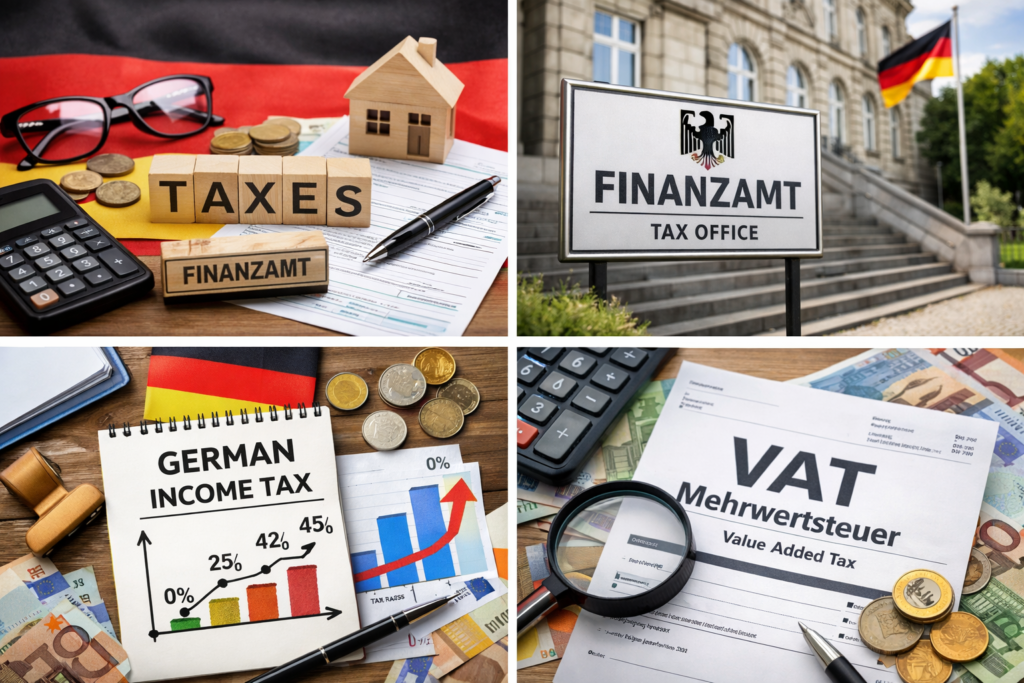
Income tax rates in Germany are progressive:
0% up to Grundfreibetrag, the basic tax-free allowance
Rates that are gradually rising
The “rich tax” is a maximum rate of 45% for extremely high incomes.
The pay-as-you-earn system often deducts income tax from employees’ salaries every month (Lohnsteuer).
Surcharge for Solidarity (Solidar Münzszuschlag)
An additional tax known as the solidarity surcharge was first implemented to aid in the development of eastern Germany. Today:
It represents 5.5% of the total amount of income tax.
The majority of people with low and moderate incomes are now exempt.
It may still be paid for by wealthy people and businesses.
Kirchensteuer, or church tax
You could have to pay church tax if you are officially enrolled as a member of a recognized church:
Depending on the state, 8% or 9% of income tax
Income tax is automatically collected.
Formally quitting the church is one way to opt out (Kirchenaustritt). (continued….)